LG webOS Device Compatibility

What to know about low-latency streaming, control, and power on LG webOS TVs

LG webOS is still in the review process for our app. In the meantime, you can sideload our app very easily. Please read how to do that here.
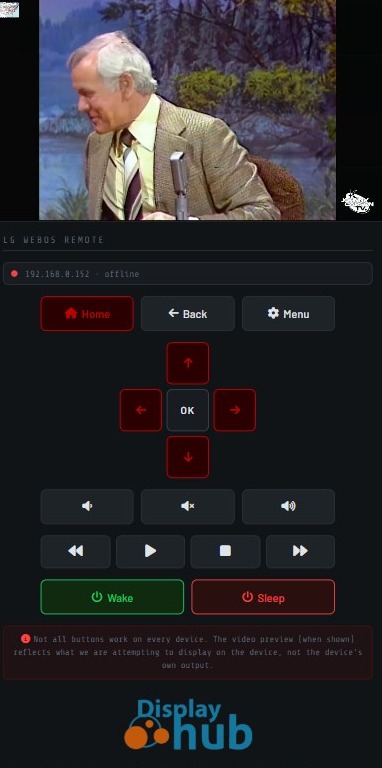
Using DisplayHUB with LG webOS TVs

DisplayHUB works directly with LG smart TVs running webOS, allowing you to stream live video and control playback without needing an external streaming device. This makes deployment simple — but performance and functionality depend on both the TV hardware and system settings.

Unlike external streaming boxes, the media player and system resources are built into the television. That means decoding performance, audio processing, and network stability all rely on the TV’s internal processor and software version.

This guide explains what to expect, how to configure your TV correctly, and how to get the most reliable performance and control.

Step 1: Install the App

While our app is in LG’s review process, install it by sideloading through webOS Developer Mode. It’s a one-time setup and requires a free LG developer account. Full step-by-step instructions are here.

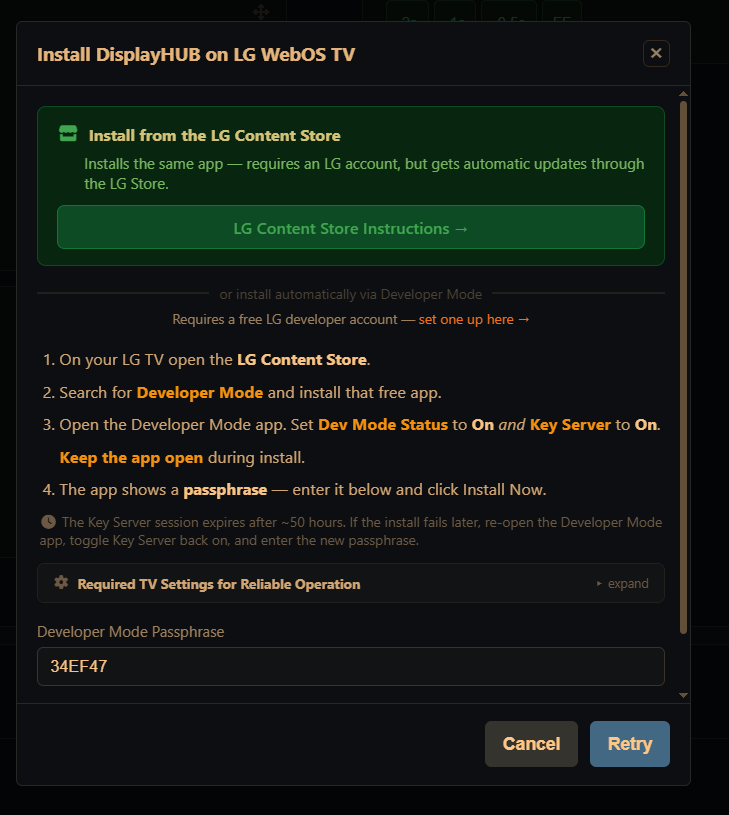
Once Developer Mode is enabled on the TV, DisplayHUB installs the app for you straight from the dashboard — open the TV’s card, click Install, enter the passphrase from the LG Developer Mode app, and you’re done.

DisplayHUB dashboard installer for LG webOS

Note: the Developer Mode “Key Server” session expires after roughly 50 hours. If an install fails later on, re-open the LG Developer Mode app, toggle Key Server back on, and use the new passphrase.

Step 2: Enable App Control & Network Settings

For DisplayHUB to communicate with your LG TV, remote control access must be enabled in the webOS settings. Without it, the controller cannot send commands or manage playback.

You must enable mobile / app control before connecting the TV. On most LG webOS TVs:

  • Open SettingsGeneral (or Connection)
  • Open Devices / External Devices or Network
  • Enable LG Connect Apps and Mobile TV On

The exact wording varies by webOS version, but these settings allow external devices like DisplayHUB to control the TV over the network. When first connecting, the TV may display a permission prompt — accept it to allow control.

Just as important: webOS TVs power down their network chip in standby unless you tell them not to. The settings below keep the TV reachable so streaming reconnects automatically and the Power On button can wake it.

Required TV Settings for Reliable Operation

  • QuickStart+ (2021 & older): Settings → General → QuickStart+ → Enable
  • Always Ready (2022+): Settings → General → Always Ready → Enable
  • Mobile TV On (Wake-on-LAN): Settings → General → Mobile TV On → Turn on via Wi-Fi → Enable
  • LG Connect Apps: Settings → Network → LG Connect Apps → Enable
  • Auto Power Off: Settings → General → Energy Saving → Auto Power Off → Disable or increase

Required Settings
LG Connect Apps + Mobile TV On

Enable network control from DisplayHUB

QuickStart+ / Always Ready
Keeps the TV reachable in standby
(needed for auto-reconnect & Power On)

Step 3: Power, Volume & Remote Control

DisplayHUB controls your LG TV directly over the network — power, volume, mute, and source/channel switching — using webOS’s built-in control service. No IR blaster or external hardware is required.

Power Off / Sleep: Works any time the TV is on. DisplayHUB sends a turn-off command over the network.

Power On (Wake): Uses Wake-on-LAN. The TV can only be woken over the network if it keeps its network alive in standby, so Mobile TV On must be enabled along with QuickStart+ / Always Ready (see Step 2). Wake-on-LAN works over both wired Ethernet and Wi-Fi on supported models. Keep the TV plugged in — deep energy-saving modes can disable the network chip and prevent remote wake. If Power On is unreliable, a wired Ethernet connection is the most dependable.

Volume & Mute: Use the TV’s native volume and mute, so on-screen feedback matches the physical remote.

First connection: webOS shows a pairing prompt the first time DisplayHUB connects. Accept it once and the controller is remembered for future commands.

Power Off
Works any time the TV is on

Power On (Wake)
Needs Wake-on-LAN →
enable “Mobile TV On” + QuickStart+

Why TV Hardware Matters for Low-Latency Streaming

Standard streaming apps like Netflix or YouTube use large playback buffers — often 30 seconds or more. This hides processing delays and network variation.

Low-latency streaming works differently. DisplayHUB keeps the buffer extremely small to minimize delay. That means your TV must decode video and process audio in near real-time.

Newer LG TVs with faster processors handle this easily. Older or entry-level models may show occasional audio dropouts, buffering, or delayed playback — especially when running for long periods.

Because televisions are not designed specifically for ultra-low-latency streaming, performance can vary significantly by model year.

Standard Streaming
Large buffer → hides performance limits

Low-Latency Streaming
Minimal buffer → real-time processing required

Common Symptoms on Older or Slower TVs

Intermittent audio dropouts: Brief silence or crackling while video appears normal. Audio processing is often the first to struggle when CPU resources are limited.

Playback stalls when switching sources: Some TVs take longer to establish new low-latency sessions.

Audio/video sync drift: Audio slowly becomes out of sync during extended playback.

Performance changes after long run time: TVs may reduce processor speed to manage heat, especially in warm environments.

If you experience these symptoms, switch to HLS playback mode in DisplayHUB. HLS uses larger buffers and is more tolerant of hardware limitations, but latency increases (typically 6–12 seconds). webOS plays our low-latency WebRTC stream well on most models, so only switch to HLS if real-time playback is unstable.

Network Connection Recommendations

Low-latency streaming is sensitive to network stability. WiFi interference or signal fluctuation can cause playback interruptions even on powerful TVs.

Best practice: Use a wired Ethernet connection whenever possible.

Most LG TVs include built-in Ethernet ports. In commercial environments or dense WiFi areas, wired networking significantly improves reliability — and it also makes remote Power On (Wake-on-LAN) far more dependable.

Modern home WiFi networks typically perform well, but Ethernet removes a major source of variability.

Summary

DisplayHUB works well with LG webOS TVs, but proper setup is essential.

  • Install the app via Developer Mode sideload while it’s in LG’s review process
  • Enable LG Connect Apps + Mobile TV On to allow control, and accept the pairing prompt
  • Enable QuickStart+ / Always Ready so the TV stays reachable in standby for auto-reconnect and remote Power On
  • Power Off works any time the TV is on; Power On uses Wake-on-LAN and needs the network kept alive in standby
  • Newer TV models provide better low-latency performance
  • Ethernet is recommended for both stability and reliable remote wake
  • HLS mode is available if real-time WebRTC playback is unstable

With correct configuration, webOS TVs provide a simple and clean way to deploy DisplayHUB without external streaming hardware.

Need help configuring your specific LG model? Contact us — we’re happy to help.